
Workshops/Speaking/Trainings
Real content, built for your room.
Workshops, talks, and trainings on mental health, sustainable performance, and the questions adults are actually asking.
What this is
Most mental health speakers have one talk. They deliver it the same way to a tech meetup, a corporate retreat, a university audience, and a community group. The audience either connects with it or does not.
This is not that.
The way I work, the talk gets built for the room. The underlying material draws from real clinical frameworks, existential psychology, and what I see in my practice every day. But the language, the structure, and the examples shift depending on who is actually in the seats. A room of founders gets one version. A room of parents gets a different one. A room of students gets a third. The substance is consistent. The delivery meets each audience where they are.
This is the same discipline that makes therapy work across populations. It is not a different skill. It is the same one, applied to a group instead of an individual.
What I have actually done
The talks have been delivered to a mix of professional, academic, and community audiences:
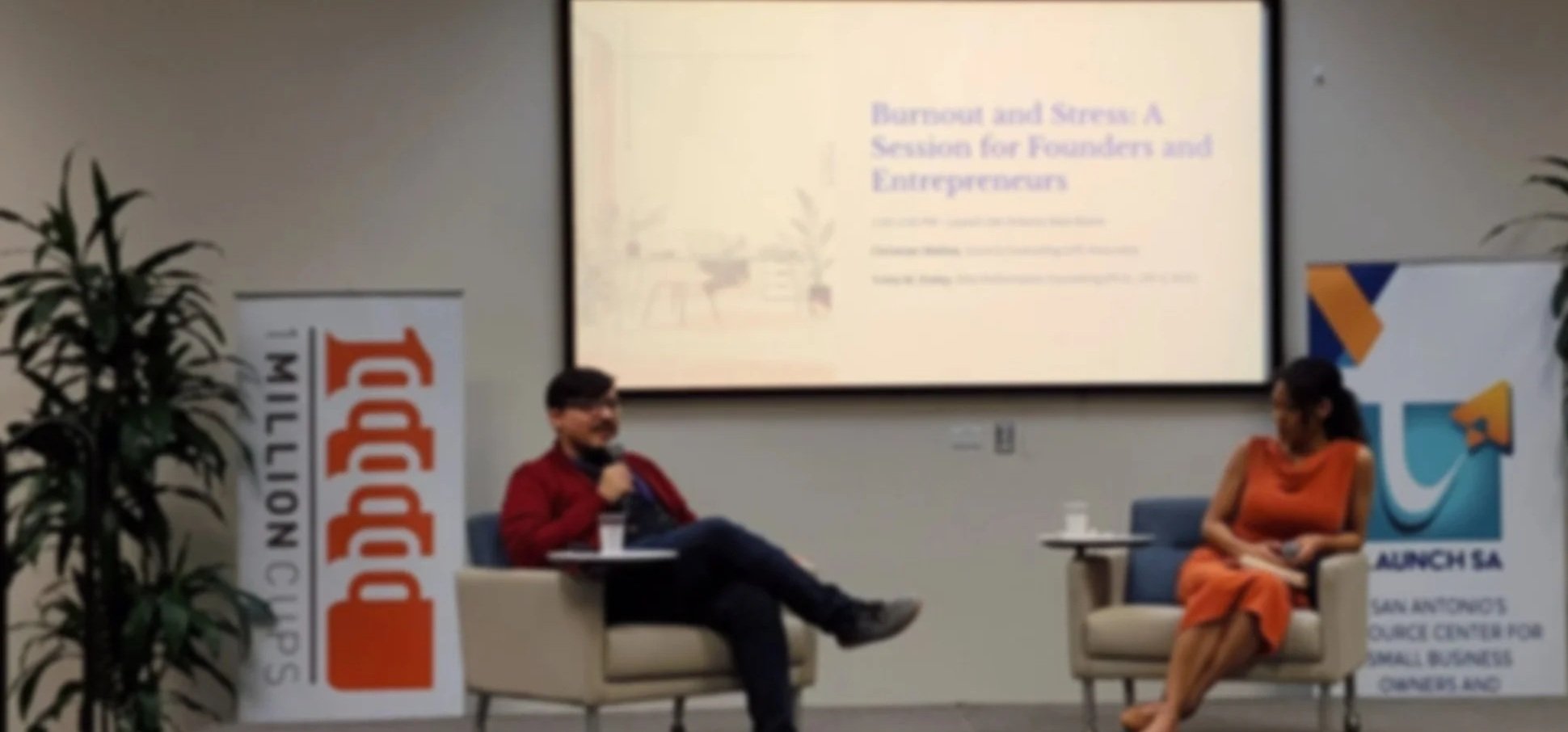
Founder and entrepreneur audiences through LaunchSA, including "Staying Sharp Without Breaking," a talk on sustainable performance and the nervous system reality of running a business.
Tech and creative audiences through Geekdom and Geeks&&, including a talk on AI sycophancy and the cost it carries for how humans relate to themselves and to others.
University audiences at St. Mary's University, including a presentation as part of St. Mary's Business Week in April 2025, and at Prairie View A&M University in collaboration with Dr. Felicia Scott of the Bexar County Cooperative Extension.
Professional associations, including a presentation at a Texas Festival and Events Association (TFEA) conference, on mental health in high-pressure event production environments.
Parent and family audiences, including a talk on meaning, flexibility, and the unseen strength of parenting children with disabilities.
Community groups and clinical audiences on neurodivergence, ADHD in adults, men's mental health, and bilingual mental health access.
Talks are available in English, in Spanish, or bilingually depending on your audience and your needs.
How I think about this work
I do not approach speaking as a separate thing from clinical work. The room is the client. The talk is built the way a treatment plan is built: by asking what the audience is actually carrying, what they need to leave with, and what would make the time we have together useful rather than performative.
This means a few things in practice.
I ask real questions before the talk. Who is in the room? What is the context? What have they already heard on this topic, and what has not landed? What is the actual problem the booking is trying to solve? The talk gets built from those answers, not from a stock outline I am adapting on the fly.
I bring clinical substance, but I do not require the audience to learn clinical vocabulary. The frameworks underneath are real (existential psychology, ACT, attention to the nervous system, the work of values-driven living), but the language on the stage is the language of the room. Founders hear it one way. Parents hear it another. The depth is the same; the delivery changes.
I do not promise outcomes. A good talk can shift how a room thinks, surface useful questions, and give people language they did not have before. It cannot replace clinical work, and I will not pretend otherwise. What I can promise is that the talk will be real, will be tailored, and will respect the intelligence of the people in the room.
I do not deliver content I am not qualified to deliver. The work stays within my actual scope. If you are looking for content I cannot ethically provide, I will tell you directly and, where possible, point you toward someone who can.
What I get asked to talk about
The most common topics cluster around a few areas:
Mental health for founders, entrepreneurs, and small business owners. Burnout, the nervous system reality of building something, the cost of always being on, the difference between sustainable performance and white-knuckling. Useful for incubators, accelerators, founder communities, and small business associations.
Neurodivergence in adults. ADHD, autism, AuDHD, the work of late diagnosis, masking and unmasking, executive function as a real cost rather than a moral failing. Useful for professional associations, university communities, employee resource groups, and clinical audiences.
Sustainable performance and the cost of doing too much. Burnout, the window of tolerance, the nervous system realities of high-pressure work. Useful for high-stress professions, event producers, healthcare workers, founders, and creative professionals.
Mental health and technology. How attention, identity, and relationship are being shaped by the tools we use. Useful for tech communities, design professionals, and audiences thinking about the cost of always being plugged in.
Parenting and family work. Meaning and flexibility for parents, including parents of children with disabilities, parents working through their own family-of-origin material, and parents navigating the gap between the parent they wanted to be and the parent they have time to be.
Bilingual and bicultural mental health. The clinical and cultural realities of doing this work across languages. Useful for academic audiences, community organizations, and clinical training contexts.
Custom topics built for your audience. If your room needs something specific that is not on this list, ask. The answer is often yes, if it is within scope.
Formats
The format is built to fit what your audience actually needs:
Talks and keynotes (30, 45, or 60 minutes) for conferences, association meetings, and community events. Real content delivered to a larger audience, with time for Q&A.
Workshops (60 to 120 minutes) for smaller groups that want to do some actual work, not just hear about it. Interactive, with attention to what the room is bringing.
Half-day and full-day trainings for professional groups, clinical audiences, and teams that need substantive content with time to integrate it.
Series built around a specific topic or population, delivered over multiple sessions. Useful for academic settings, organizational training, or community engagement projects.
Looking for something for your audience?
Get in touch and tell me about the room. I will get back to you with whether this is a fit, what the talk could look like, and what next steps would be. Rates are scaled to the size and budget of the engagement, with sliding consideration for nonprofit, academic, and community contexts.